SCHEMA
Scalable Compositional Hierarchies for Evolvable Multi-agent Architectures
A framework for the modular synthesis, adaptation, and verification of multi-agent autonomous systems — composing autonomy both horizontally across heterogeneous agents and vertically across the layers of each agent's stack.
A Center of Excellence for Compositional Autonomy
SCHEMA is an Air Force Office of Scientific Research (AFOSR) and Air Force Research Laboratory (AFRL) University Center of Excellence, established under the FY25 program on Compositional Optimization, Dynamical Systems and Control (CODAC). It unites five research groups across four institutions, the Massachusetts Institute of Technology (lead), the California Institute of Technology, the University of California, Berkeley, and the University of Pennsylvania, around a single question: how do we build autonomy that can grow?
Tomorrow's missions will be carried out not by a single robot but by evolving teams of heterogeneous agents, such as drones, humanoids, legged and wheeled robots, working together in dynamic, uncertain, and contested environments. Today, the pieces of their autonomy (control, planning, learning, and system integration) are designed in isolation, producing architectures that are brittle and hard to change. Adding a new platform, swapping a sensor, or revising a mission can mean re-engineering the whole stack.
SCHEMA's central idea is compositionality: the ability to guarantee how a whole system behaves from the way its parts are put together, both horizontally, across agents in a fleet, and vertically, across the layers of a single agent's autonomy stack. By giving these compositions a common, formal language, we aim to make autonomy architectures that are modular, scalable, safe, and able to evolve over time without being rebuilt from scratch.
Our research is organized around three interlocking themes. In Theme A — Horizontal Composition, we compose a fleet of heterogeneous agents, matching what each platform needs against what it provides so the team stays interoperable and scalable as agents are added or reconfigured. In Theme B — Vertical Composition, we decompose a single agent's autonomy stack — from high-level decision-making down to trajectory planning and real-time control — so the layers stay consistent and safety is preserved end to end. In Theme C — Global–Local Integration, we bring the two together, making the structure inside each agent compatible with the structure across the fleet, and reasoning about how agent-level and fleet-level capabilities trade off. The figure below illustrates how the three fit together.
Read more about the vision, meet the people, or browse our publications.
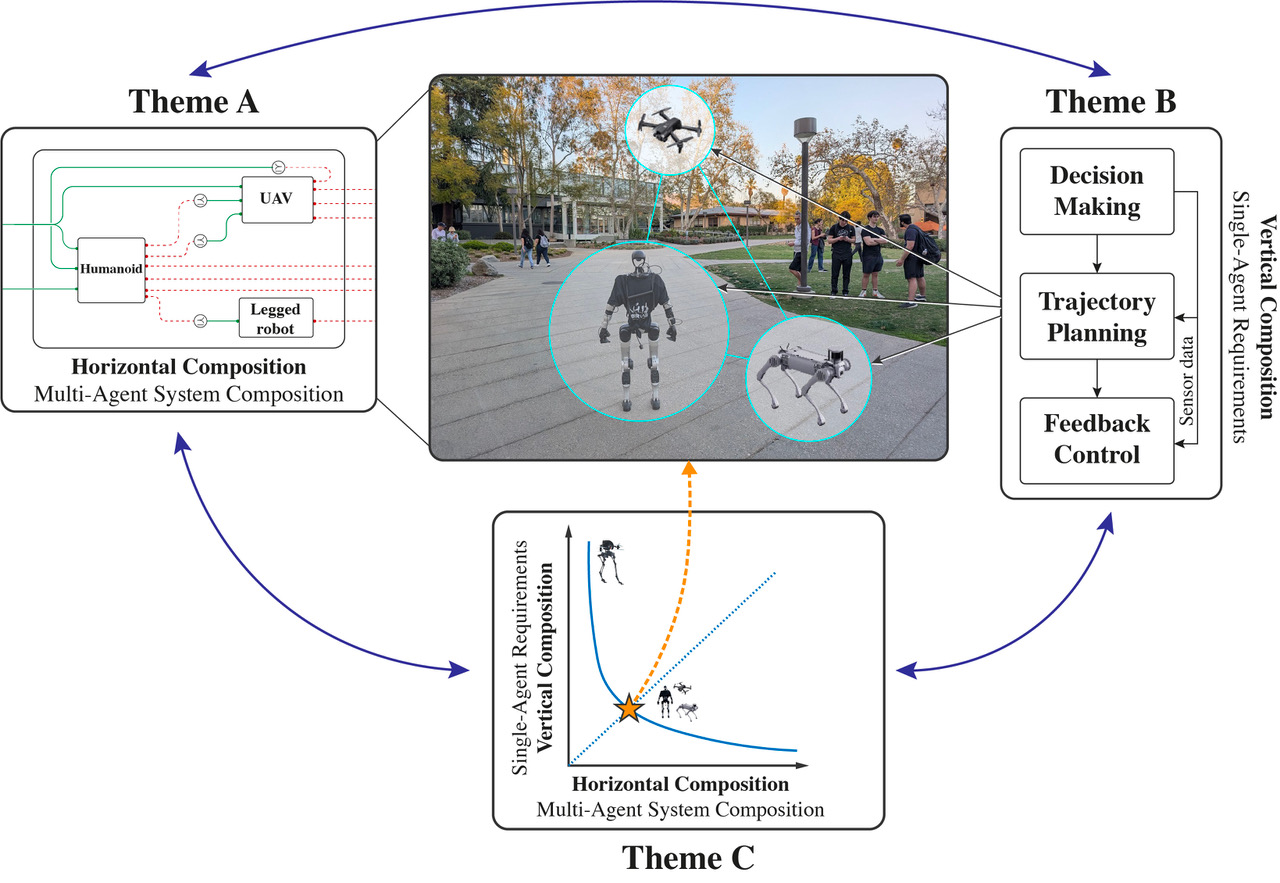
SCHEMA's three themes: horizontal composition across a heterogeneous fleet (Theme A), vertical composition within each agent's autonomy stack (Theme B), and their unified global–local integration (Theme C).
Upcoming Events
- SCHEMA Kickoff Meeting — GMU, September 24, 2026.
See the full events page for classes and activities connected to the center.
News
09/2026 - Save the date: the SCHEMA Kickoff Meeting will be held at George Mason University on September 24, 2026.07/2026 - We are excited to announce SCHEMA — Scalable Compositional Hierarchies for Evolvable Multi-agent Architectures — a new AFOSR/AFRL University Center of Excellence under the FY25 Compositional Optimization, Dynamical Systems and Control (CODAC) program, led by MIT with partners at Caltech, UC Berkeley, and the University of Pennsylvania.
07/2026 - The SCHEMA website is live! Stay tuned as we build out the center's people, publications, and events.
For the entire list of news, please refer to news!
Partner Institutions